The pace of change and the nature of the transition in any business or region will vary. Market pressures and regulatory drivers are different across the globe. Therefore, there are differing views in the market about just how quickly it will take to pivot away from fossil fuels. Of course, this is an iterative process with no fixed end point. The global energy market is evolving to produce a mixed and ultimately balanced combination of energy sources. This systematic market shift will continue for decades.
Many respondents to the QMUL and Pinsent Masons study said they think the fallout from Russia’s war in Ukraine will delay the global energy transition. In its energy outlook for 2023 (53-page / 2.2MB PDF), however, bp said it expects the effects of the war to accelerate the energy transition, based on the “increased importance placed on energy security” and the associated drive to “shift away from imported fossil fuels towards locally produced non-fossil fuels”.
What is clear is that the war in Ukraine has had an impact on global prices for fossil fuels and that sustained high oil and gas prices make it more likely that existing fields will be operated for longer.
In seeking to decouple their country’s energy security from their reliance on sourcing fossil fuels from Russia, many western governments have outlined plans to increase domestic low carbon energy generation capacity. Therefore, renewable sources of energy are expected to make an increasing and accelerated contribution to the energy mix of countries in the short to medium term.
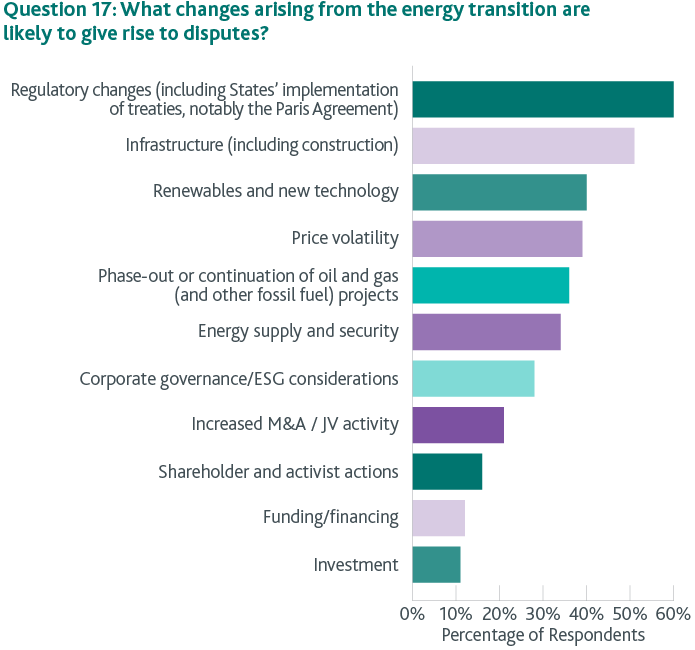
However, the race to scale up renewables capacity will provide an environment for greater disputes. Several factors will contribute to the risk of dispute. Pressure on planning and building consenting, the competition between renewable technologies, limitations within the supply chain, untested technology, competition over funding and state aid, accelerated building programmes, disputes between JV partners and grid capacity and connection issues.
There is a finite number of suppliers and contractors capable of delivering major new renewable energy projects. We expect to see competition for their services and the products they supply – from wind turbines to solar cells – increase. Supply chain availability issues are a common cause for delay which can indirectly lead to disputes arising from associated issues like budget overspend, funding issues and pricing pressures.
For renewable projects in remote greenfield locations specifically, another cause of dispute could be delay arising from the difficulties in getting the assets connected to the electricity grid.
As large incumbents in the energy market seek to repurpose assets and diversify their own product and service offerings, as carbon capture, use and storage (CCUS) and hydrogen solutions emerge, for instance, many are partnering with so-called ‘cleantech’ providers via joint venture (JV) arrangements.
JVs are a popular mechanism for bringing businesses with different strengths together to innovate and commercialise solutions at scale, but as many respondents to the QMUL and Pinsent Masons study recognise, JV activity can give rise to disputes.
With any JV, choosing the right partner is important to avoid frictions arising. In oil and gas, the investment and profit profiles of incumbents are typically measured in decades, while technology providers have a short-term outlook. These differences in commercial expectation will need to be managed to avoid frustration and dispute.
There are inherent risks associated with any new technology. Disputes arise from design development and patent conflicts, performance requirements, defects, operation and maintenance, interface issues with other infrastructure and technology. This means that when negotiating terms, prospective JV partners will want to carefully consider risk allocation in respect of performance, defects and warranties.
On the one hand, large energy businesses may wish to push the bulk of the risk onto the technology provider that developed the underlying solution, but often it will be the energy business that has more financial clout and which is better able to stand behind risk. As was the case in the European biomass market a few years ago, failing to get the balance of risk right can put small technology providers at risk of liquidation which in turn puts JV-led projects at jeopardy.
As requirements are updated and new standards set, and as environmental, social and corporate governance (ESG) issues become more important factors in investor decision-making, so businesses should expect greater scrutiny of their practices – shareholder activism and climate-related litigation is on the rise.
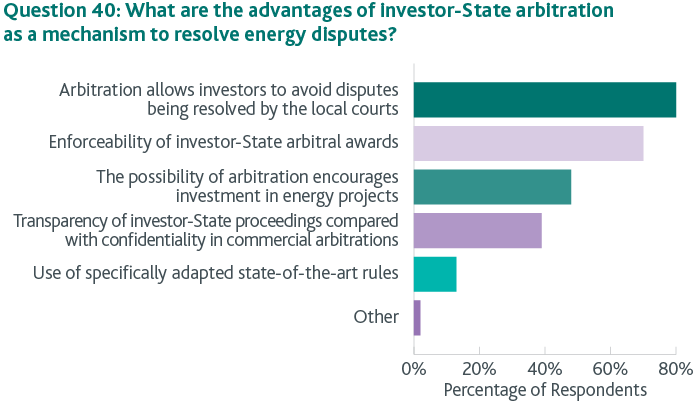
Policy and regulation, flowing from international commitments made by governments, will continue to drive and shape the energy market and determine where funding is channelled. However, changes to state policy and financial incentives over time has and will continue to lead to significant disputes between foreign investors and state organisations. Many of these large energy investment disputes are resolved in investor-state arbitration.