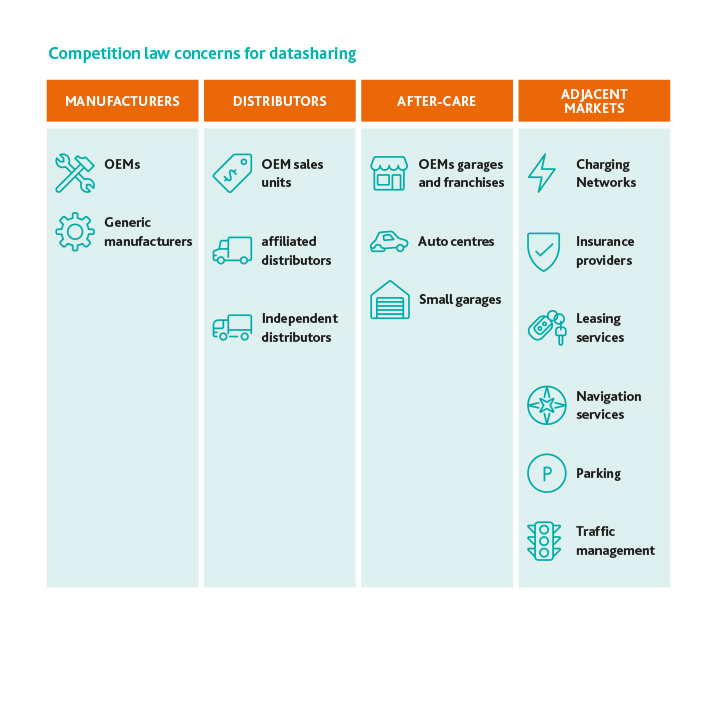
Holding a dominant position is not illegal, but dominant companies have a 'special responsibility' not to abuse that position and restrict or distort competition as a result by either exploiting customers or excluding competitors.
A dominant company must not act in a way to restrict or distort competition on any market, even where it is not present. It is irrelevant whether the dominant company actually receives any benefit as a result of its actions. This can pose issues for companies who act as a gatekeeper to an asset to which access is indispensable for third parties to compete, known as 'essential facilities', regardless of whether the gatekeeper is also active in the downstream market.
OEMs that refuse to supply data could be considered to be abusing a dominant market position even if they are not themselves active in the downstream market. A breach could arise in this context if:
- access to the OEM-controlled dataset is indispensable to compete in a separate market;
- competition in the separate market would be effectively eliminated without access to the data; and
- there is no objective justification for the refusal to supply.
The type of data matters
The competition law risk associated with sharing data or refusing to share data often depends on the context of the market on which the data sharing occurs and on the type of data. In this respect, a distinction can be made between OEM-specific data and non-OEM specific data.
OEM specific data
Data related to repair and maintenance will be OEM specific and not substitutable or interchangeable with other OEM data. Consumers are effectively locked in for a sustained period of time after they have purchased a vehicle and therefore each OEM is likely to have its own aftermarket.
Competition authorities are concerned that this gives each OEM a degree of market power within its own ecosystem, and competition between OEMs is not sufficient to guarantee effective competition in the after-care market.
Competition law can require that access to such data must be granted on fair, reasonable and non-discriminatory (FRAND) terms in order to promote effective competition.
Pricing should not discriminate between different parties being granted access for the same application, and the terms of access should be reasonable – for example, where real-time access is required, it should be granted and any charges should not be excessive.
In determining whether the charge is reasonable, the use for which the data is required should be borne in mind and the value of the data for that application can be taken into account.
Non-OEM specific data
Much of the data that will be produced by connected vehicles which could be relevant to other ancillary markets will be less OEM specific. Establishing market power for such data will require a more detailed assessment of the facts in each individual case. Where market power is not established, the OEM would have greater flexibility with regards to access pricing and other terms of access.
Future regulation of connected vehicles data
A fundamental question remains as to how to address the vast quantities of data being produced by connected vehicles.