Manufacturers or importers of plastic packaging, including importers of packaging which already contains goods, need to ensure they comply with the tax.
The rate of tax is £200 per metric tonne of plastic packaging.
Plastic packaging tax (PPT) is an environmental tax designed to provide a financial incentive for businesses to use recycled plastic in the manufacture of plastic packaging. The government envisages this will create greater demand for recycled plastic, stimulating increased levels of recycling of plastic waste and diverting it away from landfill or incineration.
Packaging subject to the tax
A charge to PPT arises when a chargeable plastic packaging component is produced in the UK by a person acting in the course of a business or where it is imported into the UK on behalf of such a person. It only applies to ‘finished’ products.
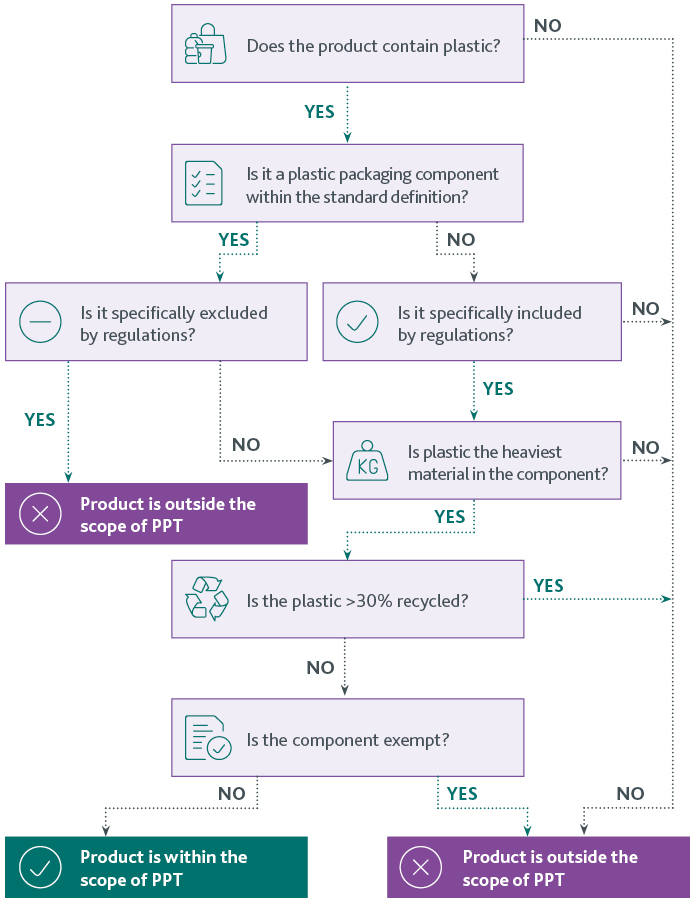
A ‘packaging component’ is a product that is designed to be suitable for use, whether alone or in combination with other products, in the containment, protection, handling, delivery or presentation of goods at any stage in the supply chain of the goods, from the producer of the goods to the consumer or user. This is a wide definition which catches items which may not be thought of as packaging such as coat hangers. It also covers reusable and refillable items such as plastic crates and intermediate bulk containers (IBCs).
If the packaging component meets the definition, it does not matter if it is produced or imported for use in the supply chain of the goods, or by a consumer or user.
Imports of packaging which already contains goods, such as plastic bottles filled with drinks or plastic packaging around goods, are also potentially subject to the tax with some exclusions. The exclusions apply to filled packaging components with a primary storage function, such as glasses cases or DVD cases; and where the packaging is an integral part of the goods, such as printer cartridges or tea bags.
PPT is not charged on plastic packaging which is designed to be reused for the presentation of goods such as shop fittings or sales stands.
Products are also subject to PPT if they are designed as single use packaging products for use by a consumer or user in containing any commodity or waste. This means that plastic bags, bin liners, nappy sacks, disposable cups and such like are subject to PPT.
Plastic content
Even though the tax is designed to have environmental benefits, plastic includes biodegradable, compostable and oxo-degradable plastics.
Each component needs to be considered separately. For example, for a plastic drinks bottle, a business needs to consider the bottle itself, the lid and any plastic label separately.
Packaging that contains multiple materials but contains more plastic by weight than any other single substance is a plastic packaging component for the purposes of the tax. For example, if a 10-gram item of packaging is made up of four grams of plastic, three grams of aluminium and three grams of cardboard, all 10 grams is considered plastic packaging for the purposes of the tax.
The producer or importer will need to be able to demonstrate to HM Revenue & Customs (HMRC) that a packaging component which contains plastic is not subject to the tax. If they cannot demonstrate this, the component will be treated as entirely plastic. Records need to be kept as to the materials used in the manufacturing of the packaging and the weight of each material. Methods for weighing plastic packaging components and the requirements for maintaining, producing evidence of and calculating recycled material in plastic are set out in regulations.
Meaning of finished
A plastic packaging component is chargeable only when it is ‘finished’. A component is finished if it has undergone its last substantial modification, or in cases where the last substantial modification happens when the component is packed or filled, its last substantial modification before being packed or filled.
A substantial modification is any process that changes the shape, thickness, weight or structure of a packaging component.
The UK business which performs the last substantial modification before the packing or filling process is the one which is liable to pay PPT. A business which imports plastic packaging components which have already undergone their last substantial modification is liable for PPT.
Exemptions
Four types of packaging component are exempt from the tax, regardless of how much recycled plastic they contain. These are:
- plastic packaging manufactured or imported for use in the immediate packaging of a medicinal product;
- transport packaging used on imported goods;
- packaging used as aircraft, ship and rail stores;
- components that are permanently designated or set aside for use other than a packaging use.
There is also a deferral of liability to the tax for plastic packaging which is exported that meets the direct export condition.
Medicinal use
Plastic packaging manufactured or imported for use in the immediate packaging of a medicinal product is exempt from PPT. For these purposes a ‘medicinal product’ is either any substance or combination of substances:
- presented as having properties of preventing or treating disease in human beings;
- that may be used by or administered to human beings with a view to restoring, correcting or modifying a physiological function by exerting a pharmacological, immunological or metabolic action, or making a medical diagnosis.
Veterinary medicines are not exempt. ‘Immediate packaging’ is the container or other form of packaging immediately in contact with the medicinal product.
Importantly, even if the exemption applies, it is necessary to include this type of exempt packaging in assessing whether more than 10 tonnes of plastic packaging is manufactured or imported in a 12-month period to establish whether the business needs to register for the tax. The same is true for packaging set aside for non-packaging use, but not the other two types of exemption.
Exported packaging
Where plastic packaging is intended for export, payment of the tax can be deferred for up to 12 months as long as certain requirements are met. If the packaging is exported within the 12-month period, the liability for PPT is cancelled.
We have prepared a simple flowchart to follow when considering whether particular components fall within the scope of PPT.