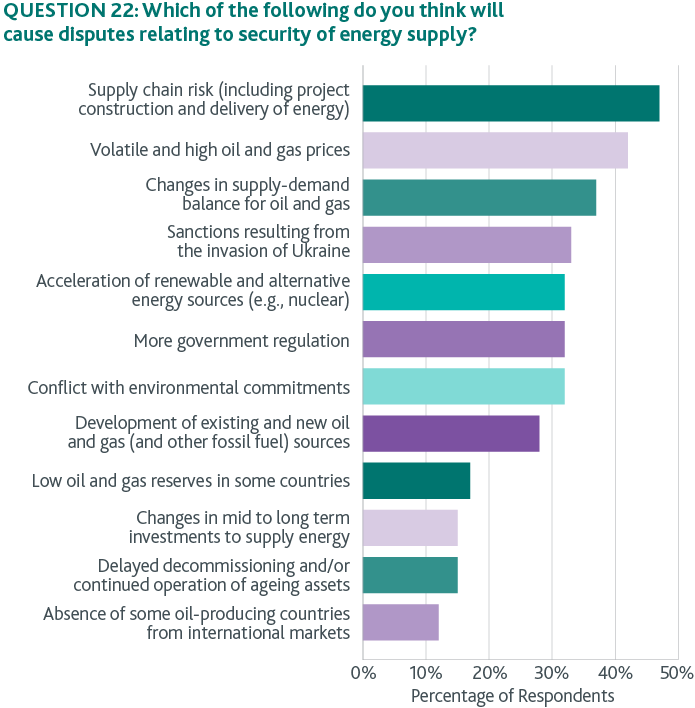
According to the respondents, matters concerning security of energy supply will be one of the primary causes of the most international energy disputes in the short to medium term. When asked to rank factors which they think will cause disputes relating to security of energy supply, 47% of respondents identified supply chain risk, recognising that geopolitical tensions like those arising from the war in Ukraine only serve to put added pressure on supply chains that faced significant challenges throughout the Covid-19 pandemic. Other interconnected risk factors – price volatility and sanctions – scored highly as likely causes of security of supply disputes too.
In Western countries, beyond the imposition of sanctions , there has been a significant policy response to the war in Ukraine. In Europe, for example, some countries have moved to expand gas storage capacity and others have sought to source gas from other jurisdictions in light of the threat of Russia withdrawing its supply of gas to them. This has had an impact on global gas supply availability and pricing, not just in the European market.
The desire to reduce reliance on Russian fossil fuels has also encouraged many Western policymakers to examine how this can be achieved in the wider context of achieving climate change targets. The REPowerEU plan is an example of this, which envisages a greater focus on domestic, clean, energy generation.
The acceleration of renewable and alternative energy sources, such as nuclear, was also identified by respondents to our study as a likely cause of disputes relating to security of energy supply as policymakers seek to address longer term need – 47% of respondents indicated that the cost of nuclear projects would be the factor most likely to lead to disputes in the context of nuclear projects.
Some respondents to our study, however, believe that energy security pressures, exacerbated by geopolitical tensions, will spur a shift in Africa, the Middle East, and Asia back to traditional sources of fossil fuels, and others see potential for previously abandoned fossil fuel projects to resurface and resultant disputes arising from reversing decommissioning. The long-term direction of travel towards cleaner energy seems set, however, and so short-term changes to the investment environment and regulatory framework aimed at addressing security of supply concerns have the potential to lead to disputes between foreign investors and host states in the longer term if these policies are reversed.
There are, however, different views on how energy security issues will impact on the energy transition – some respondents expect the renewed focus on security of supply to cause delay to the energy transition, but bp said recently (53-page / 2.2MB PDF) that it expects the opposite. In our experience, however, there are geographic nuances: outside of Europe, including the more economically-developed Middle Eastern countries including Saudi Arabia and the UAE, we see acceleration of the energy transition.
In many parts of regions such as the Middle East, there are no directly applicable sanctions or regulatory changes linked to the Russia-Ukraine conflict. Instead, there is a continued focus on clean energy and renewables with those projects moving ahead at speed. For example, Saudi Arabia is investing heavily in clean hydrogen production and renewables such as wind and solar as it aims to achieve net zero carbon emissions by 2060. In the UAE, the UAE energy strategy 2050 aims to achieve an energy mix combining nuclear, renewables and clean energy sources to meet the UAE's economic requirements and environmental goals by 2050. The country has already seen significant investment in nuclear and solar energy.
Whilst there are regional variations in the areas of impact of security of energy supply, an almost uniformly negative impact has been on the supply chain. Disruption of the global supply chain of materials needed for construction projects continues to be a problem, together with associated price volatility and escalation of raw materials and energy. This leads to a greater number of disputes as project timetables are delayed and scopes of work need to be varied, whether those projects are for the production of fossil fuels or renewables.